
Digital Liquid Chromatography with All‑Carbon Microbeads: Applications in Sample Cleanup, PFAS, Multi‑Omics, and RNA QC
Electrochemically modulated liquid chromatography (EMLC; also referred to as digital chromatography) uses an applied electric potential to control analyte retention, especially for those with permanent or

transient charge. In conventional liquid chromatography, analyte retention is primarily determined by the analyte type, the stationary phase, and the mobile phase. In EMLC, an applied potential provides a dynamic means to alter surface interactions on a conductive medium in real time, enabling real-time selectivity tuning during a run rather than relying solely on fixed column chemistry. The implications of this extra control in real workflows are:
Cleaner sample preparation
More selective removal of nuisance compounds
A path toward simplifying downstream chromatography itself
An electrically conductive stationary phase is a key foundation for EMLC. Our all-carbon microbeads make that kind of control practical inside a chromatography format. Their electrical

conductivity enables the use of applied potential as an additional separation variable, alongside mobile-phase composition, flow conditions, and column geometry. They enable a single platform to serve multiple workflow roles, from sample cleanup and enrichment to more advanced chromatographic separations that depend on charge, hydrophobicity, or related intermolecular interactions.
Readers who want a deeper technical primer on how carbon microbeads facilitate EMLC can begin with the earlier explainer article, since this post focuses on where the technology may fit rather than restate all the fundamentals.
Below is an overview of ongoing, and planned applications.
1. Natural product drug discovery. One of the clearest application areas is sample preparation for natural product discovery. Complex extracts often contain nuisance compounds such as tannins and polyphenols that can suppress signal, foul downstream methods, or obscure the molecules that researchers actually want to study.
In that setting, all-carbon EMLC media could serve as a smarter solid-
phase extraction step. Carbon already has a strong affinity for many aromatic and hydrophobic species,

and voltage control may provide an extra degree of selectivity for capturing, holding, or releasing unwanted compounds before analytical HPLC or LC–MS begins.
The key takeaway here is that EMLC could offer a tunable sample preparation strategy for complex mixtures. Fixed media often require a compromise between retention and release.
2. PFAS and persistent contaminants
PFAS handling in analytical and purification workflows is another area of interest. These chemically persistent compounds:
Contain hydrophobic and charge groups
Are structurally diverse
Are often present in low concentrations inside already complicated matrices
As a result, PFAS detection in complex samples typically requires carefully staged extraction and LC–MS methods. An all-carbon EMLC platform may be useful here for two reasons.
1) Carbon surfaces are already relevant to adsorptive cleanup
strategies.
2) Electrochemical control opens the possibility of tuning retention and elution behavior more deliberately than with a passive sorbent alone.

We are exploring EMLC for PFAS-related workflows to support and complement existing extraction and analytical methods, with the goal of enabling more selective capture and release of target species.
3. Multi-omics and complex analytical workflows. An electrically tunable carbon platform is attractive for multi-omics (e.g., genomics, proteomics, metaboomics, lipidomics) workflows. Low-abundance analytes, matrix effects, and narrow windows for sample cleanup are common in their sample-preparation workflows prior to final readout. Thus, even small gains in selectivity can have a large practical effect on downstream data quality.
In these workflows, EMLC provides a flexible interface between the crude sample and the final readout. Depending on the application, the same underlying media can be deployed for enrichment, desalting, matrix reduction, fractionation, or selective retention of problematic compounds that interfere with LC–MS performance. All-carbon conductive media are being investigated for several workflow pain points that benefit from tunable interactions.
4. RNA manufacturing process analytics and quality control. RNA manufacturing process analytics and quality control (QC) expand the use of EMLC beyond sample
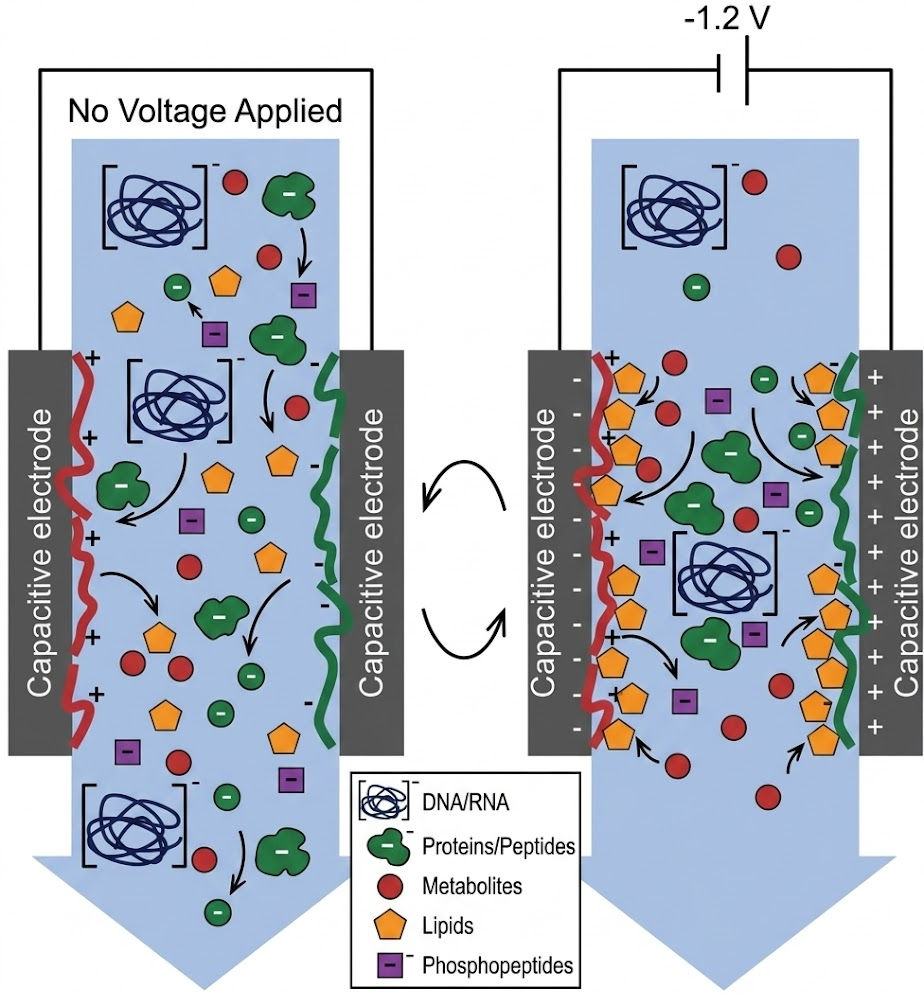
preparation and into chromatography. Current RNA QC often relies on multiple orthogonal methods, including reverse-phase, anion-exchange, and size-exclusion separations, to interrogate critical quality attributes (CQAs) such as capping efficiency, poly(A) tail properties, dsRNA content, impurities, aggregates, and overall RNA content.
The long-term opportunity for EMLC in this area is not simply another cleanup cartridge. It is possible that a voltage-tunable all-carbon column could probe several of these attributes on a single compact platform by shifting surface behavior during the separation, rather than requiring multiple dedicated columns and instrument setups for each property of interest. That makes RNA a valuable application to include even in a broad overview post, because it shows that the platform is not limited to pre-HPLC sample preparation and may eventually play a role in consolidating multiple analytical workflows around a single conductive separation medium.
Summary and next steps. The common thread across these diverse applications is that they all involve difficult separations. Media with fixed chemical composition can be limiting. An extra control variable could help laboratories get more from the same workflow footprint.
As the platform advances towards commercialization, our focus is on developing products and techniques that reduce method complexity and create more adaptable analytical systems. The goal is to reduce the burden currently spread across separate cleanup, reverse-phase, ion-exchange, and related workflows.
For inquiries or collaborations, or if you are interested in evaluating NanoPak-C all-carbon microbeads, please contact our technical team at inquiry@millennialscientific.com, call us at 855 388 2800, or fill out our online contact form at www.millennialscientific.com/contact.
References.
1) J.A. Harnisch, M.D. Porter, Electrochemically modulated liquid chromatography: an electrochemical strategy for manipulating chromatographic retention, Analyst 126(11) (2001) 1841-1849.

